
The RBI Grade B exam is one of the competitive exams to build your career in the finance and banking sector. However, the journey of cracking the RBI Grade B exam demands a strong foundation.
Many aspiring candidates, like you, often find themselves overwhelmed by the vast RBI Grade B syllabus and the difficulty level of the subjects. Don’t worry! You must know that building a strong foundation is the first step towards your RBI Grade B dream.
In this article, we’ll explain how to build a strong foundation for your upcoming RBI Grade B preparation.
Understand the Exam Structure
Before directly jumping into your preparation, you need to know the RBI Grade B exam pattern and syllabus. There are 2 phases in the exam:
Phase 1:
RBI Grade B Phase 1 includes 4 subjects:
- General Awareness (80 marks)
- English Language (30 marks)
- Quantitative Aptitude (35 marks)
- Reasoning Ability (35 marks)
Phase 2:
RBI Grade B Phase 2 consists of 3 papers:
- Economic and Social Issues (ESI) (100 marks)
- Finance and Management (FM) (100 marks)
- English (Descriptive) (100 marks)
After understanding the pattern, here you can find the detailed RBI Grade B syllabus.
This knowledge of the RBI Grade B exam pattern and syllabus will help you make necessary changes to your preparation and avoid unnecessary distractions.
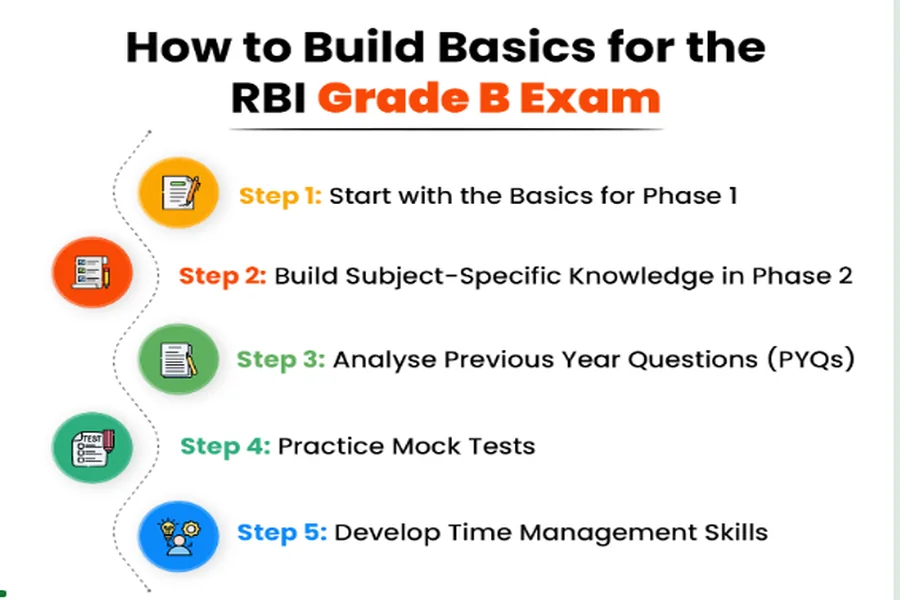
Step 1: Start with the Basics for Phase 1
Building a solid foundation for the RBI Grade B exam begins with understanding the core concepts. It will help you answer both easy and complex questions. Here’s how to approach the foundational learning:
General Awareness
- Current Affairs: Begin by reading daily newspapers such as The Hindu, The Economic Times, or Business Standard. Focus on topics related to economics, banking, and finance.
- Government Schemes & Reports: Familiarize yourself with major government schemes, economic reports (e.g., Economic Survey), and RBI reports.
Quantitative Aptitude
- Basic Mathematics: Revise basics of topics like percentages, profit and loss, time and work, ratio and proportion, simple and compound interest, averages, and number series.
- Practice Basic Problems: Start solving basic-level questions to improve your speed and accuracy. Use books such as RS Agarwal or Quantitative Aptitude by Arun Sharma for practice.
Reasoning Ability
- Logical Reasoning: Understand different types of reasoning problems, such as number series, coding-decoding, blood relations, directions, puzzles, and seating arrangements.
- Puzzle Solving: Start with simple puzzles and gradually move to more complex ones. Focus on learning tricks to speed up solving.
English Language
- Grammar: Revise English grammar rules, including tenses, prepositions, articles, and conjunctions.
- Reading Comprehension: Develop a habit of reading newspapers and articles. Try to get familiar with different writing styles.
- Vocabulary: Make a daily habit of learning new words and their meanings. Use vocabulary-building apps or notebooks for regular practice.
Step 2: Build Subject-Specific Knowledge in Phase 2
Once you’ve covered the basics of Phase 1, it’s time to dive deeper into the specific subjects that will be tested in Phase 2 of the RBI Grade B exam.
Economic and Social Issues (ESI)
- Study Basic Economics: Start with understanding key economic concepts, such as GDP, inflation, fiscal policies, monetary policies, and economic growth.
- Focus on Indian Economy: Pay attention to the structure of the Indian economy, economic planning, banking, and financial institutions.
- Social Issues: Understand social welfare schemes, education, health, poverty, and inequality.
- Government Policies: Familiarize yourself with government initiatives related to economic reforms, rural development, and sustainable development goals.
Finance and Management (FM)
- Finance Basics: Understand concepts such as financial markets, financial instruments, Primary and Secondary Markets, Basics of Derivatives, etc.
- Management Principles: Focus on basic management concepts like organizational behavior, leadership styles, human resources, operations management, and communication.
English Descriptive
-
- Essay Writing: Practice writing essays on various current topics like economic reforms, social issues, the RBI’s role in the economy, and global financial crises.
- Precis writing:
- Reading Comprehension:
Step 3: Analyse Previous Year Questions (PYQs)
After building your basics, the next step is to analyse the RBI Grade B previous year question papers.
- Go through RBI Grade B previous year question papers to understand the exam trend, the types of questions asked, and the difficulty level.
- Analyze the number of questions asked from each topic to identify high-weight areas.
Step 4: Practice Mock Tests
The next step after analyzing PYQs is to practice as many mock tests as you can
- Regularly take mock tests to simulate the actual exam environment and get a feel of the time constraints.
- Analyze your performance after each mock test to identify weak areas and work on them.
- Revise the concepts of your weak topics.
Step 5: Develop Time Management Skills
Effective time management is an important skill that you need to develop for the RBI Grade B exam. Here’s how to manage your time efficiently:
- Create a Study Plan: Divide your time between General Awareness, Quantitative Aptitude, Reasoning, and the Phase 2 subjects.
- Daily Goals: Set small but achievable goals for each day.
- Revise Regularly: Keep a dedicated time (be it 1 hr daily or the weekend) for revision to reinforce what you’ve learned. As per your revision findings, focus on weak areas and improve your speed and accuracy.
Conclusion
Building a strong foundation for the RBI Grade B exam requires time; it is a marathon, not a sprint. It requires patience, consistency, and a focused approach. By systematically working through the steps outlined above, you will lay a robust groundwork that will support your advanced preparation and significantly increase your chances of success in this prestigious examination. Remember, a strong base is the key to reaching the pinnacle of your RBI Grade B aspirations.
Table of Contents