
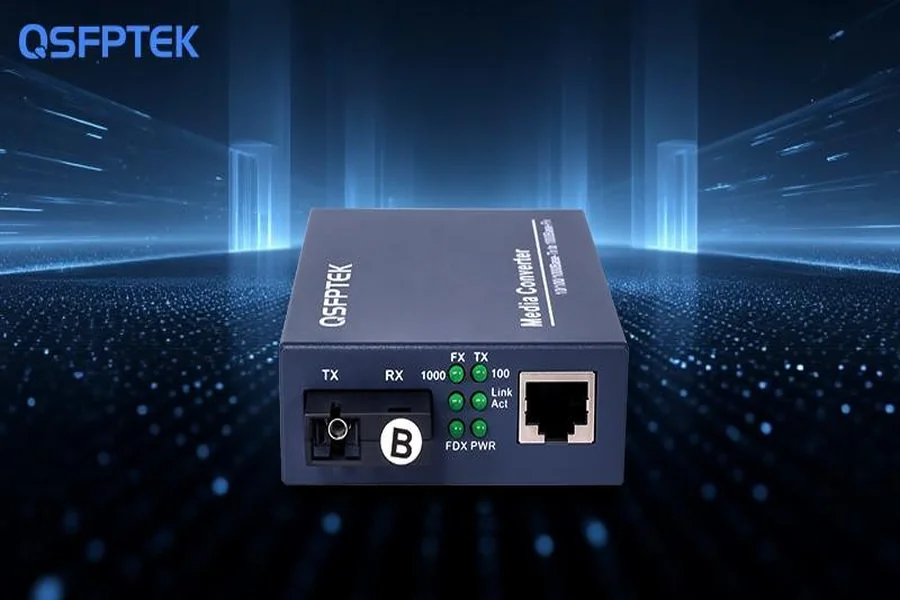
In today’s increasingly connected world, network demands are constantly evolving. While some enterprises are moving toward 10Gbps infrastructure, the reliable and cost-effective Gigabit (1 Gbps) network remains the backbone for countless businesses, campuses, and industrial applications. However, the 100-meter distance limitation of standard copper Ethernet cabling (CAT5e/6) often poses a significant challenge. This is where the Gigabit Media Converter becomes an indispensable tool. This device seamlessly bridges your existing copper-based network over much longer distances using fiber-optic cable, preserving your investment in Gigabit equipment while enabling network expansion.
What is a Gigabit Media Converter?
A Gigabit Media Converter is a simple, standalone networking device that performs a crucial function: converting electrical signals from a copper Ethernet network into optical signals for a fiber-optic network, and vice-versa. It allows two network devices with different port types—typically a 1000Base-T copper port (RJ45) and a 1000Base-X fiber port (SFP)—to communicate with each other. By doing so, it extends a network segment far beyond the 100-meter limit of UTP copper cable, leveraging the superior distance and noise immunity of fiber. These converters are essential for linking buildings, connecting remote switches, securing data in electrically noisy environments, and integrating specialized equipment like industrial machines or high-resolution security cameras into a central network.
Copper to Fiber Gigabit Media Converter
The Copper-to-Fiber converter is the most common type. It features an RJ45 port for the copper side and one or two SFP (Small Form-factor Pluggable) slots for the fiber side. For instance, the QT-BIDI-0420B is a copper to fiber media converter with a 10/100/1000Base-T RJ45 copper port and a 1000Base-X Simplex SC fiber port.
Key Functionality: It takes the Gigabit Ethernet signal from a switch, router, or server with a standard RJ45 port and converts it for transmission over fiber. This is perfect for extending a network link to a remote office, warehouse, or another building hundreds of meters or even kilometers away.
Core Advantages:
- Distance Extension: Overcomes the 100m copper barrier. Using multi-mode fiber, distances can reach 550m; with single-mode fiber, links of 20km, 40km, or more are possible.
- Immunity to Interference: Fiber is immune to Electromagnetic Interference (EMI) and Radio-Frequency Interference (RFI), making it ideal for industrial floors, elevators, or paths parallel to power lines.
- Security: Fiber does not radiate signals and is extremely difficult to tap, providing enhanced data security.
- Cost-Effective Upgrade: It allows you to add fiber capability to a network without replacing core copper switches, offering a flexible and economical path for expansion.
Fiber to Fiber Gigabit Media Converter
Fiber to fiber media converters are used to connect two different types of fiber cable.
Key Functionality: It typically has two SFP slots and performs conversion between:
- Multi-mode (MMF) and Single-mode (SMF) Fiber: Interconnects legacy, short-range MMF networks with long-haul SMF backbone links.
- Dual Fiber and Single Fiber (BiDi): Converts standard dual-strand fiber links to work over a single strand using different wavelengths (e.g., 1310nm & 1550nm), effectively doubling fiber capacity.
- Different Wavelengths: Converts between optical wavelengths (e.g., 850nm to 1310nm).
Core Advantages:
Network Integration: Enables seamless interconnection between diverse fiber infrastructures that would otherwise be incompatible.
- Fiber Type Optimization: Allows the use of cost-effective multi-mode fiber for short runs within a building while connecting to single-mode for long-distance runs between buildings.
- Fiber Resource Maximization: Single-fiber (BiDi) converters conserve precious fiber strands in congested conduits.
Why Use a Gigabit SFP Media Converter?
The use of standard SFP slots is what makes modern media converters incredibly versatile and future-proof.
- Unmatched Flexibility: You can pop in any industry-standard SFP module to match the exact fiber type (MMF/SMF), connector (LC/SC), and distance required for a specific link. Need to change from a 550m multi-mode link to a 20km single-mode link? Simply swap the SFP module; the converter chassis remains the same.
- Vendor Compatibility: SFP modules from most major manufacturers are interoperable, giving network administrators freedom of choice and avoiding vendor lock-in.
- Simplified Management: Many advanced Gigabit Media Converters feature management capabilities (e.g., Web, CLI, SNMP), allowing for remote monitoring of link status, SFP diagnostics (DDM/DOM), and troubleshooting, which is vital for critical network links.
Final Words
The Gigabit Media Converter is a proven, pragmatic solution for network expansion and modernization. It respects past investments by integrating with existing copper-based Gigabit equipment while opening the door to the superior performance of fiber optics. Its simplicity, flexibility through SFP technology, and cost-effectiveness make it an enduringly relevant tool in the network designer’s toolkit. Whether you are connecting across a campus, securing data in a factory, or maximizing the value of your installed fiber plant, the Gigabit Media Converter provides a reliable and straightforward answer. When planning your next network extension, consider this versatile device as a key component in your architecture.
Table of Contents