

Introduction
In the development process of complex parts, the information gap between design engineers and manufacturing (or supplier) teams is a common challenge. Designers may focus on functionality and aesthetics while overlooking the practical process limitations of CNC milling services, such as internal corner radii, aspect ratios, thin-wall deformation, etc. This leads to design models that cannot be machined economically and efficiently, with conflict risks being particularly high when pursuing ±0.01mm tolerance CNC milling. The core issue lies in the lack of a dynamically updated, easily accessible “CNC machining knowledge management” hub for teams, causing the same design errors to recur in different projects.
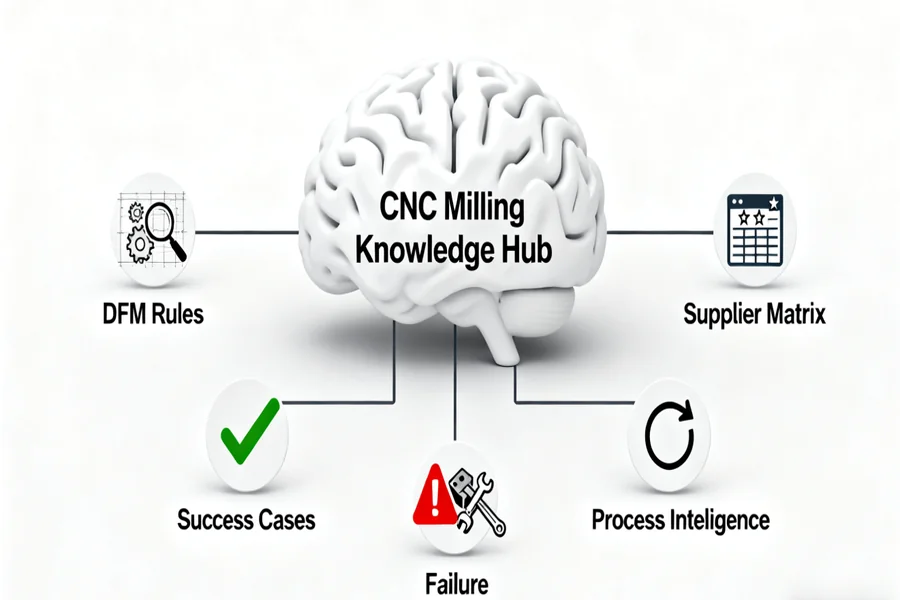
This article will explain how to create a dedicated “CNC Milling Think Tank” for teams by systematically curating a DFM resource archive, a supplier process library, and failure case analyses, enabling knowledge to flow proactively and effectively reduce conflicts.
Why is Dispersed “Manufacturability” Knowledge the Main Cause of Cost Overruns in CNC Milling?
In precision manufacturing research collaboration, information silos are the biggest cost black hole. For example, if designers are unaware that increasing surface finish from Ra 1.6 to Ra 0.8 might increase machining time by 30%, or if a team repeatedly selects a special material that previously caused delays, costs can be directly driven up. This dispersion and lack of knowledge severely impacts the precise balance of CNC milling accuracy and cost.
According to relevant research by the American Society of Mechanical Engineers (ASME), over 30% of manufacturing cost overruns can be traced back to information gaps during the design phase. When designers cannot easily access historical DFM checkpoints, material processability data, and supplier capability boundaries, their designs are essentially “blind testing,” inevitably leading to frequent conflicts. Therefore, establishing a systematic knowledge base is the foundation for cost control and achieving the goal of conflict reduction.
How to Build a Team-Specific “CNC Milling DFM Golden Rules” Library?
Building an effective knowledge base starts with systematically curating high-quality DFM (Design for Manufacturing) resource archive.This process aims to integrate scattered experiences, standards, and data into a single, searchable, and verifiable source of information, providing immediate support for team decision-making.
Define the Core Knowledge Scope
A well-structured knowledge base should cover three core layers, forming a knowledge system from general to specific. First are general DFM rules, such as recommended internal corner radii, hole depth-to-diameter ratios, and thin-wall thicknesses for different materials (e.g., aluminum, steel, titanium). Second are material-specific rules, which need to detail significant differences in cutting parameters, tool selection, and cooling strategies, for example, between aluminum alloy 6061 and stainless steel 304. Finally, process capability rules must clearly define the geometries, tolerance ranges, and surface treatment limitations that can be economically achieved in 3-axis versus 5-axis CNC milling environments; this is the foundation for handling complex parts CNC milling.
Curate High-Quality External and Internal Resources
Teams should actively and continuously collect and validate authoritative external resources. This includes the latest material data sheets from well-known suppliers (e.g., ThyssenKrupp, Bohler), and industry standards published by organizations like ASME and ISO (e.g., ISO 2768 for general tolerances). Particularly important is collecting articles that provide in-depth analysis of technical principles, such as this detailed explanation of high precision CNC milling tolerances, which systematically describes the equipment, environment, and control requirements for achieving ±0.01mm tolerances.
Simultaneously, the accumulation of internal resources holds more practical value. For instance, a medical device company, while designing a titanium alloy bone screw, successfully increased the processing qualification rate of micro-threads from 75% to 98% by archiving the supplier’s micro-milling technical white paper and internal trial processing parameters.
Integrate Internal Experience and Cases
Every project involving ±0.01mm tolerance CNC milling is a valuable learning opportunity and must be archived in a structured manner.
Success Case Library:
Not only archive the final perfect part drawings but also record successful toolpath strategies, cutting parameters (speed, feed, depth of cut), and fixture solutions. For example, the high-speed milling strategy and dedicated vacuum fixture design for a successfully processed communication device heat sink should be recorded in detail for direct reference in similar projects.
Failure Case Library:
The value of this library lies in avoiding repeating mistakes. It should detail the entire process, such as: “An aluminum alloy housing experienced chatter during machining due to its thin wall (0.4mm), leading to unacceptable surface quality; the issue was ultimately resolved by adjusting the tool overhang length, adopting a layered contouring strategy, and reducing the cutting depth to 0.1mm.” This kind of “process intelligence” based on real lessons transforms the knowledge base from a static reference into a dynamic risk early-warning and decision-support system.
How to Efficiently Curate and Evaluate the Technical Capabilities of “High-Precision Milling” Suppliers?
Choosing the right CNC milling services supplier is key to project success. Effective prototyping information curation can transform subjective, vague assessments into objective, data-driven decision-making processes, which is crucial especially when facing urgent or highly challenging projects.
Create a Supplier Capability Matrix
Teams should establish a dynamic, shared “Supplier Capability Matrix” list. Evaluation dimensions need to be comprehensive and specific, including: equipment list (brand, model, quantity, positioning accuracy, 5-axis simultaneous machining capability), material experience (paying special attention to successful cases involving special alloys or engineering plastics), quality certifications (e.g., ISO 9001, AS9100D, IATF 16949), and typical workpiece cases that best demonstrate their capabilities (e.g., images, brief descriptions).
For example, a startup in the aerospace sector, when searching for a supplier for its engine bracket, used this matrix to quickly screen three suppliers possessing DMG MORI five-axis machines and NADCAP certification, reducing evaluation time by 70%.
Implement Technical Team Resource Curation
This step requires senior engineers to be responsible for ongoing Technical Team Resource curation. Their core task is to deeply process supplier informaion.
Highlight Key Data:
Directly highlight the core capability data claimed by suppliers on their collected webpages or PDF materials, such as “Maximum travel: 2000×800×600mm” or “Minimum tool diameter: 0.5mm,” facilitating quick information retrieval.
Add Annotations and Comments:
Add internal comments next to the collected links, such as “Supplier A has 5 successful projects in the field of medical implant small parts, but lacks experience in large structural component machining, requiring further verification.”
Link Project Feedback:
Associate quality data from past collaborative projects, such as CMM inspection reports and surface roughness measurement results, as attachments or links with the corresponding supplier profiles. For instance, if a project found that the hole position accuracy of a batch of parts processed by Supplier B was consistently stable at ±0.008mm, this empirical data becomes strong evidence of their technical capability, forming a valuable closed-loop evaluation.
Dynamic Updates and Sharing
The value of a knowledge base lies in its timeliness and accessibility. A mechanism for regular (e.g., quarterly) review and update of information must be established to ensure that suppliers’ new equipment, new certifications, or capability changes are promptly captured. Simultaneously, ensure the library is highly visible and easily searchable for all design and procurement team members. This allows for the rapid identification of 3-5 potential partners with the highest capability match when initiating inquiries for new projects, significantly improving collaboration efficiency.
3-Axis, 5-Axis, or Multi-Axis Linkage? How to Use the Knowledge Base to Select the Best Milling Strategy for a Part?
The choice between 3-axis vs 5-axis CNC milling is a core decision affecting cost, cycle time, and accuracy. The knowledge base should serve as a “strategic staff” supporting this critical decision.
Take machining a housing with deep cavities and undercut features as an example. Engineers can quickly search for relevant technical white papers within the knowledge base.
By reviewing this knowledge, they can swiftly judge that using a 3-axis machine would require multiple setups, potentially leading to cumulative errors that fail to meet requirements; whereas employing 5-axis simultaneous machining, despite a higher hourly rate, allows for completion in a single setup, potentially reducing total cost and better ensuring the stability of precision CNC milling. Here, the knowledge base provides a decision-making framework and evidence, avoiding risks associated with relying solely on personal experience.
How to Enable Continuous Evolution of Milling Knowledge, Forming the Team’s “Process Intelligence”?
A static knowledge base will quickly become obsolete. A successful CNC machining knowledge management system must establish a continuous evolution mechanism.The key is to deeply integrate the knowledge base with the project workflow. After each project concludes, a “project debrief” should be conducted, producing structured notes added to the knowledge base.
For example, add a note under the “Aluminum 6061” entry: “Using new coated end mills allows increasing feed rate by 20%”; or add under the “thin-wall machining” rule: “Adopting a symmetrical milling strategy effectively controlled deformation.” Through this “contribute-apply-feedback” cycle, the knowledge base transforms from a reference material into a dynamically growing “process intelligence” system that embodies the collective wisdom of the team, becoming a core competitive advantage.
Conclusion
In the competitive landscape of product development, effective management of CNC milling knowledge has become a core capability for shortening delivery cycles and controlling project budgets. By implementing the CNC machining knowledge management system described above, teams can transform scattered experiences into reusable organizational intelligence, fundamentally enhancing the success rate of precision CNC milling projects. Start building your team’s milling knowledge base now to elevate collaboration efficiency to a new level.
If your project is facing complex milling challenges and requires a partner with a strict quality system and extensive technical experience, feel free to explore the professional CNC milling services offered by JS Precision to obtain technical support tailored to your precise needs.
Author Bio
The author is a senior manufacturing expert with over 15 years of experience in the field of precision CNC machining, specializing particularly in building efficient knowledge management systems to resolve conflicts between design and manufacturing. The process optimization solutions they led have successfully helped multiple client teams improve project delivery efficiency by over 20%.
FAQs
Q1: Is building such a knowledge management system too complex for small teams?
A1: Not at all. Start small, for example, by first creating a “Top 10 CNC Milling DFM Points” list and sharing it with team members. The benefits in improved communication efficiency and reduced errors will far outweigh the initial time investment.
Q2: How to ensure the technical articles collected into the knowledge base are reliable and up-to-date?
A2: It is recommended to prioritize collecting technical white papers from authoritative standards organizations, well-known industry media, or leading manufacturers. Regularly reviewing the list to update or replace outdated information is key to maintaining the value of the knowledge base.
Q3: Can this system help control the specific costs of CNC milling?
A3: Yes. By clarifying design rules and supplier capabilities, it helps avoid unrealistic designs and expensive machining strategy choices from the source, thus effectively controlling machining time and material waste, which constitute the bulk of the costs.
Q4: Apart from Diigo, what other tools can achieve similar knowledge management?
A4: Similar concepts can be applied to other collaboration platforms like Notion or Confluence. The core is to choose a tool that supports easy collection, annotation, categorization, and team sharing, and to persist in its use.
Q5: When evaluating CNC milling suppliers, what should be focused on besides equipment?
A5: Beyond equipment, focus should be placed on their process engineering capabilities, quality control processes (such as certification systems), and practical cases with measurement reports of parts with similar complexity they have machined previously. This reflects their true level better than a mere equipment list.
Table of Contents